

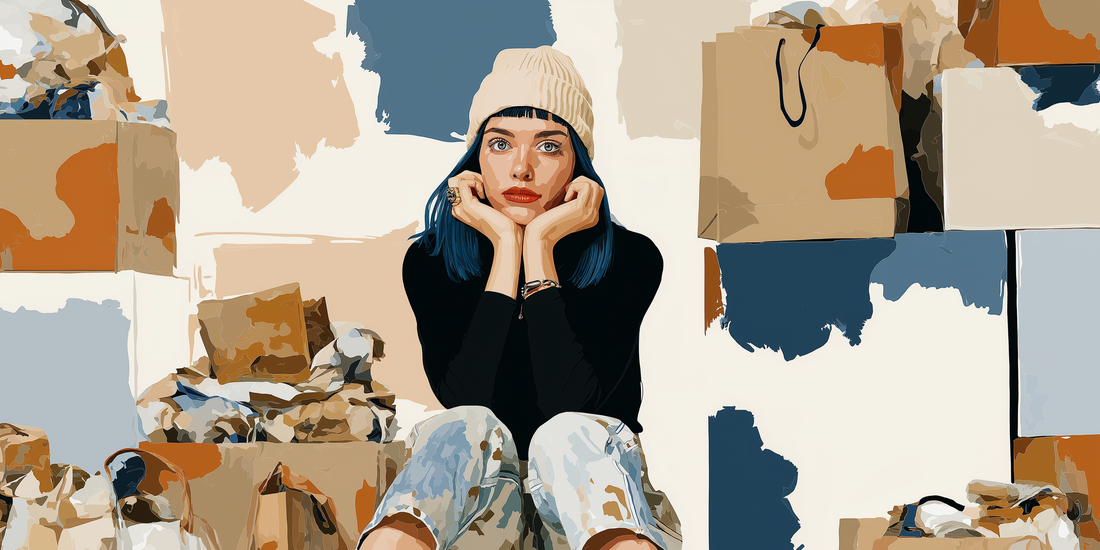
01: An Item Is Just an Item
An item is just an item — not a friend, not a status symbol, and definitely not a therapist.
We’re surrounded by objects. They grow into our routines, our memories, even into us. At first, it feels convenient — until you realize it’s no longer you choosing the items, but the items choosing you. You’ve become not a person, but a storage function. A closet of dreams.
In today’s world, an item has stopped being just an item. It’s become a symbol. A status. A proof that you still exist. People collect pairs of shoes, yet stop walking — stop moving, growing, living.
Because those shoes aren’t for walking through life; they’re there so that if you must stand still, at least you don’t have to face the silence — the silence in which, finally, you might hear yourself.

Conscious Consumption — When You Buy Knowing the Purchase Won’t Make You a Better Version of Yourself
The point isn’t to own nothing. The point is to not let things own you. When we choose something, what matters isn’t only how it looks — but why we need it. The philosophy of design isn’t just about beauty. It’s about the courage to ask a hard, almost brutal question:
“Why the hell do I need this?”
That’s what conscious consumption truly means — to stay awake while the world around you keeps buying dreams.

Marketing, Manipulation, and the Great Cult of “Must-Have”
We live in an age of substitution — where want has quietly turned into must. And the rule is simple: hurry, or you’ll miss out.
Because it’s “almost sold out.”
Because it’s “fast delivery.”
Because “everyone has it.”
But who said it’s yours to begin with?
The Mass Market Taught Us This: the more you have, the more you are. Your clothes speak for you, your kitchen shouts, and your chair becomes the business card of your soul. They’re not selling you items — they’re selling you identity.
But the key to that identity has always been yours. The moment you buy into the illusion of self-improvement through consumption, you stop being the creator — and become the creation. Shaped from someone else’s palette, painted in colors that aren’t truly yours.
No color becomes your own until it’s the result of a conscious choice.

The Legacy of Scarcity: Shelves Full, Heart Empty
Our choices are often not choices at all — they’re echoes of inherited fear. A generation raised in scarcity doesn’t believe it’s possible not to stockpile. So we buy — more, a little more, just in case.
Conscious consumption and mindful choice are acts of trust, not fear. Trust in yourself, and in your own identity.
Ask yourself about every item around you:
– Does this item truly serve me and reflect who I am?
– Does it align with my values?
– Does it belong in my space — or does it silently push me out of it?
When the answer is honest, the item becomes an ally — or it leaves your life.
To live is to know who you are — without things, without age, without a name.
We fear emptiness.
But sometimes, emptiness is the only space where we can finally meet ourselves.
Thematic Art Gallery


Let’s Summarize
Becoming one step closer to conscious consumption begins with a few simple but honest questions:
- Do I already own something similar?
- Is this truly unique?
- Do I need it, or does it just look nice sitting (or lying, or standing) there?
And most importantly:
- Could I live without it — and what would actually change in my life? Think it through — from how that sweater rests in your closet (neatly folded, tossed in a rush, lost among others)to how you feel when wearing it —is it comfortable, practical, does it truly reflect you, or was it just another reaction to a fleeting trend?
We’re not against items. We’re for items that don’t consume you — but help you form your identity.
We’re for a world where aesthetics and functionality serve, not dominate.
We’re for the right to own less, but be more.
When we finally admit that an item is just an item, we reclaim our freedom — not from the shop window, not from clever ads, but from within. And that’s where the journey begins — not of a consumer, but of a creator of one’s own environment.
Not the one who keeps running after the new, but the one who stands still. Silently. In the quiet. Listening — until their own path reveals itself.

 https://salviri.store

